PhD researcher · Mizoram University
AngsumanDas
PhD researcher — computational microbiome & machine learning
Pachhunga University College, Mizoram University, Aizawl, India
- 8peer-reviewed publications, 2019–2024
- 97.5percentile, CSIR-UGC NET Junior Research Fellowship
- 2022teaching undergraduate zoology since
- 7.0IELTS Academic overall band (C1)
Research
My PhD asks whether cattle that live alongside people — especially free-roaming urban strays that feed on human food waste — are acquiring human-associated gut microbes and antimicrobial-resistance genes, a process I study as microbiome humanisation. Framed within One Health, the project compares wild, farmed and urban bovines using shotgun and amplicon metagenomics, with interpretable machine learning to separate the effects of diet, human contact and environment. Alongside it I am preparing HydroSink, a pre-registered meta-analysis of hydrogen-sink pathways across vertebrate gut metagenomes. I trained in zoology and applied bioinformatics, have built RNA-seq, eDNA metabarcoding and de novo transcriptome workflows for collaborators, and have taught undergraduate zoology since 2022. I am looking for a research internship during my PhD and, later, a postdoctoral position in a microbiome or computational-ecology group.
Featured projects
-
HydroSink In preparation
Pre-registered cross-vertebrate meta-analysis of how gut communities partition hydrogen among its microbial sinks, built on public metagenomes.
-
Spider species identification from morphology
Five classifiers compared on morphological characters from 45 spider species, with SHAP explanations of which traits drive each identification.
-
Wetland eDNA metabarcoding Paper submitted
18S V4 and COI plankton metabarcoding of Chandubi Beel and Deepor Beel (a Ramsar site) in Assam, from raw reads to annotated communities.
-
RNA-seq expression profiling
Per-sample transcriptome quantification and functional annotation for four samples, delivered as a reproducible pipeline with an interactive report.
-
Bioinformatics learning hub
An open teaching resource with ten guided labs across genomics, transcriptomics, proteomics, metagenomics and structural biology.
Publications
Peer-reviewed
- Das A, Das B (2024). GPT Vision meets taxonomy: a comprehensive evaluation for biological image classification. In Proceedings of the NIELIT's International Conference on Communication, Electronics and Digital Technology, Lecture Notes in Networks and Systems, Springer, pp. 427–441.
- Sudan P, Modi G, Albuquerque M, Jena A, Das A (2024). Clinical applications of mass spectrometry in toxicological investigations: advancing therapeutic drug monitoring and analysis. Journal of Applied Bioanalysis 10(1): 114–128.
- Das A (2024). Conversational interfaces in bioinformatics: bridging computational power and user accessibility. International Journal of Chemical and Biochemical Sciences 25(15): 251–254.
- Ravish P, Suhasini KP, Keshamma E, Niketh S, Shobha N, Das A, Singh VH (2023). A green solution to industrial dye pollution: exploring the advancements in nano material-based photocatalysts. International Journal of Chemical and Biochemical Sciences 24(9): 329–334.
- Das A, Raj A, Snigdha VG, Meitei KR, Kaur K (2021). Analysis of the physico-chemical parameters of river Bohimora in the Sonitpur district of Assam and evaluation of its macro-invertebrate diversity. International Advanced Research Journal in Science, Engineering and Technology 8(11). DOI as printed: 10.17148/IARJSET.2021.81126.
- Das A (2021). Cultural zoology: unveiling the ethnozoological tradition of Assamese tribes. Journal of Advanced Zoology 42(2): 243–249.
- Das A (2021). Green heritage of Assam: a comprehensive meta-analysis of traditional medicinal practices. Journal of Advanced Zoology 42(1): 171–178.
- Das A, Chetry R (2019). Aquatic remedies: an ethnopharmacological study of fish-based medicines in Assam's tribal villages. Journal of Emerging Technologies and Innovative Research 6(5).
Other writing
- Das A. Prospecting of Lepidopteran silk and derivatives: recent developments. Book chapter in Research Insights of Life Science Students, Vol. 2. ISBN 978-81-947154-5-0.
- Life-Science-Book — open study notes for the CSIR NET and GATE Life Sciences examinations.
No preprints at present. The authoritative list is on ORCID.
Skills, with evidence
- Amplicon & eDNA
- Primer trimming, ASV inference and taxonomic assignment for 18S and COI markers (cutadapt, DADA2, PR2, BLAST).
- Transcriptomics
- Reference-based RNA-seq (fastp, HISAT2/Bowtie2, featureCounts, DESeq2) and de novo assembly with completeness checks (Trinity, BUSCO).
- Machine learning
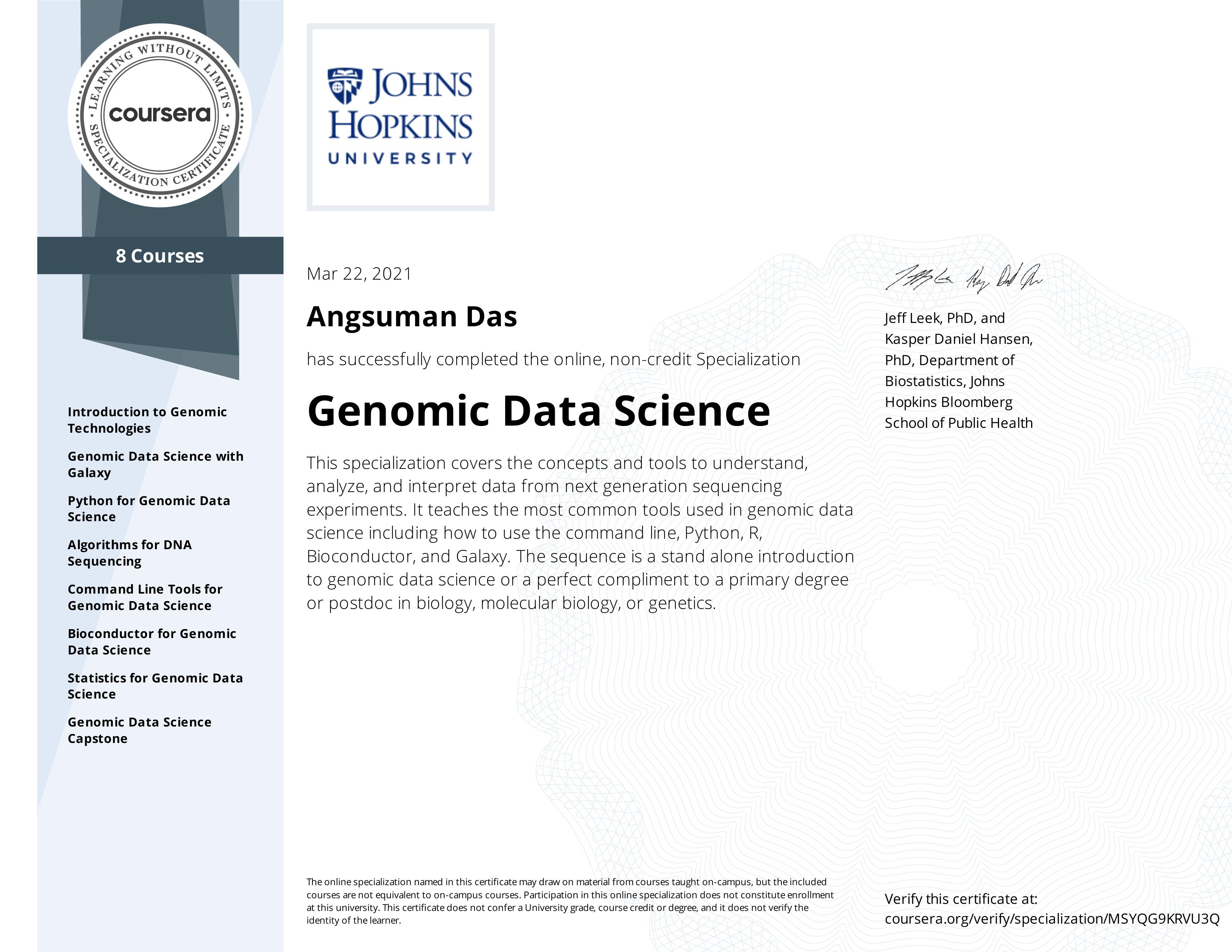
- Supervised classification, model comparison and SHAP-based interpretation in scikit-learn; evaluation of multimodal AI for taxonomy.
- Structural bioinformatics
- Homology modelling and structural validation of human Toll-like receptors.
- Computing
- Python (pandas, SciPy, statsmodels), R, Bash, conda environments, Git.
- Teaching
- Undergraduate zoology since 2022, plus open bioinformatics teaching material.
Education, teaching & experience
- 2026 –
- PhD, Life Sciences — Pachhunga University College, Mizoram University
Thesis theme: humanisation of the cattle gut microbiome (One Health).
- May 2022 –
- Assistant Professor (Tutor), Department of Zoology — Tyagbir Hem Baruah College, Jamugurihat, Assam
Undergraduate zoology theory and laboratory teaching.
- Mar – Oct 2021
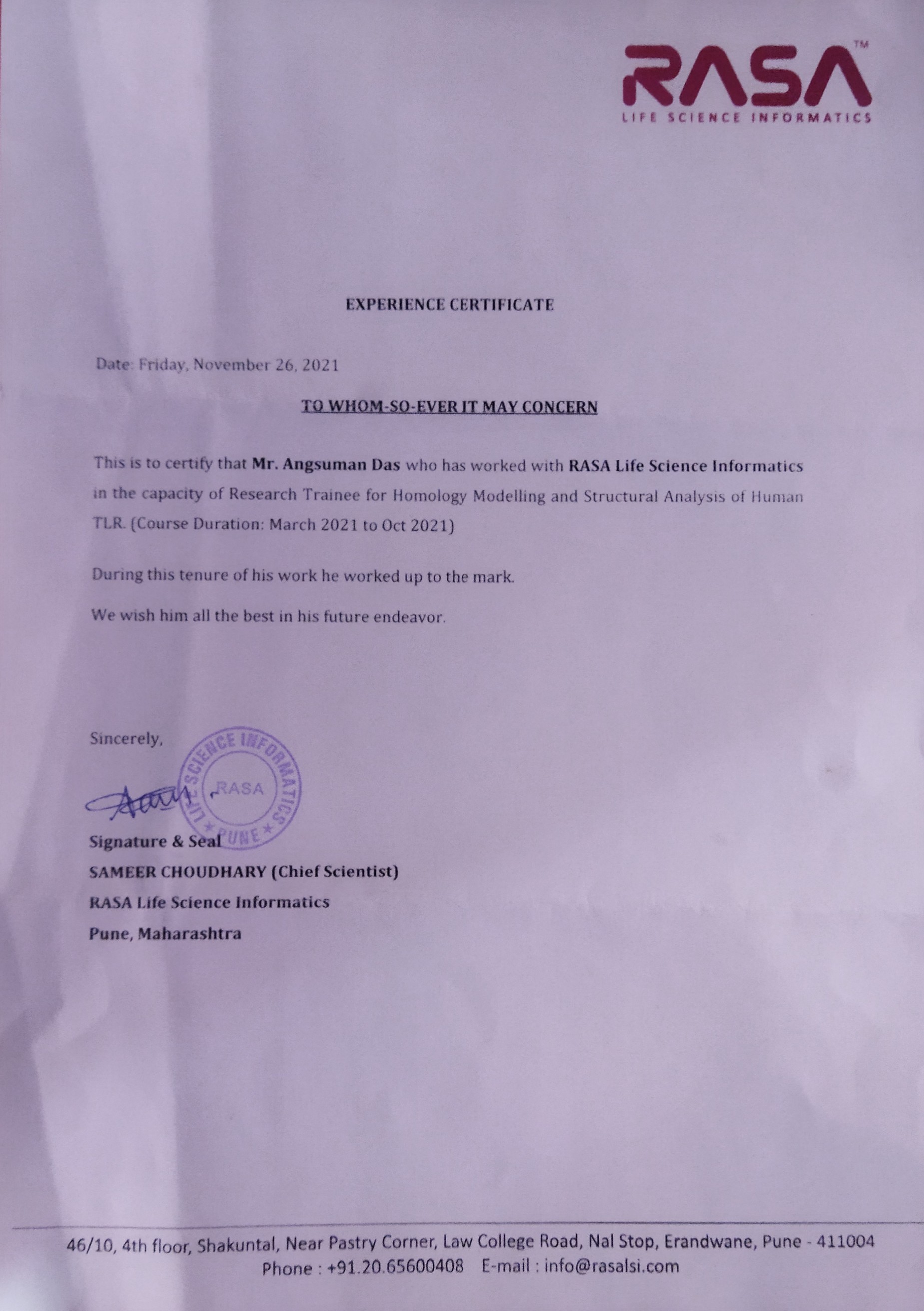
- Research Trainee — RASA Life Science Informatics, Pune
Homology modelling and structural analysis of human Toll-like receptors.
- 2020
- M.Sc. Zoology — Rajiv Gandhi University, Arunachal Pradesh
Dissertation on bioprospecting of Lepidopteran silkworms.
- 2018
- B.Sc. Zoology (Major) — Darrang College, Tezpur; Gauhati University
Dissertation on water quality and macro-invertebrate diversity of the Bohimora river.
Fellowships & awards
- 2023
- CSIR-UGC NET Junior Research Fellowship, Life Sciences (December 2022 – June 2023 cycle)
97.50 percentile, rank 180; 78,168 candidates appeared.
- 2021
- IELTS Academic — overall band 7.0 (CEFR C1); December 2021
Contact
- Alternate emailangsuman.das@rgu.ac.in
- Phone / WhatsApp+91 78965 05109
- ORCID0000-0001-8146-7697